Przejdź do treści
jtc.org.pl
NEWS
ABOUT
PROJECTS
EVENTS
GALLERY
OFFER
CONTACT
ABOUT
Just Transition Culture
About the Project:
The Just Transition Culture project emerged from cooperation between activists and artists from regions in Romania, Greece and Poland transitioning away from coal. By showcasing cultural expression, it explored issues of identity within the context of an ongoing transformation through concerts, dance & theatre performances, exhibitions, study visits, workshops, murals and installations, creating a blend of artistic forms in a shifting cultural landscape.
Read more…
The Just Transition Culture project emerged thanks to cooperation between NGOs from coal regions in Romania, Greece and Poland. Envisioned as a cultural supplement to the Annual Political Dialogue (APD) for Coal Regions in Transition in Konin Poland in June 2025, we showcased the culture of the regions and explored issues of identity within the context of an ongoing transformation. The programme included concerts, theatre and dance performances, exhibitions, study visits, murals and installations, as
well as art workshops, all with the participation of artists from 3 regions: Western Macedonia in Greece, Jiu Valley in Romania, and Eastern Wielkopolska in Poland.
Highlights:
The Blue Crocodile
– art project led by Ion Barbu, Romanian artist and initiator of the ‘Planeta Petrilla’ project, repainting an electric mining locomotive to create a living sculpture. The famous 'Crocodile’ is to be preserved and put on display once coal mining and transport operations cease
Study visit
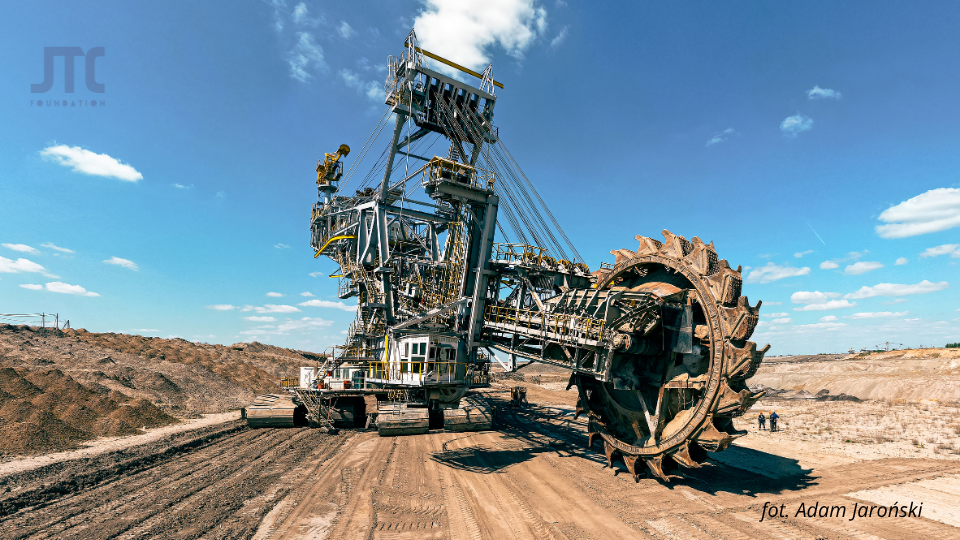
– touring the DOLORES excavator, with JTC organisers and mining
employees acting as guides
International Table
– artistic fusion of cuisines of 3 regions, emphasis on traditional cuisine of the region, by Boguszyce Housewives’ Association under guidance of artist Magdalena Deput
Murals
by Silesian artist Karol Kobryń, merging regional folk art styles with the concept of new green energy.
Poszeter Jid
– performance of Kolski Open Theatre group recounting the 80-year industrial history of the Konin Basin, including the difficult WWII period and first discovery of coal
Exhibitions
by Polish and Greek artists Magdalena Deput, Paweł Kaszczyński, Adam jaroński, Łukasz Łukasiewicz, Antonis Balakas and Stergios Adam.
Art workshops
by artists from Florina and Poland, with creation of collaborative collages.
Concerts
– music performances by PAK KWB Konin Miners’ Brass Orchestra and Fanfara Avantura from Poland, Romanian Tinutul Momarlanilor and Greek Florina Modern Ensemble; dance by Konin Dance Theatre from Poland and Lygkistes from Greece on the stages of the Konin Cultural Centre.
The story of the Project.
The idea of organising a cultural event bringing together artists and activists from transitioning regions had been floating around for a few years in many a conversation. Through our work as local & international activists working on the just transition, Miłosława Stępień & Mariusz Harmasz from Konin in Poland, Kostas Filippidis & Simos Konstantinou from Florina in Greece and Adina Vintan from Jiu Valley in Romania came together to create the event. All three places are currently undergoing a transition away from coal. We decided on the date as linked to the Annual Political Dialogue on Coal Regions in Transition in Konin, Poland in 2025. Mariusz Harmasz took on the organisation of the event, and that’s how the crazy journey began. It was organised by this handful of people from 3 countries, getting increased amounts of individuals and institutions involved, primarily by sharing with them our passion and excitement about the project. While the initial vision was much grander (a huge event for thousands of people), we ultimately scaled it down, still managing to bring over 50 artists and activists from across Poland, Jiu Valley in Romania and Florina in Greece to the town of
Konin. While the activists from Konin organized the venue, sponsoring, event
programme, accommodation, catering and all the little things necessary to make a 5- day international event possible, our friends from Greece and Romania took care of all the matters necessary for their artists to embark on their journey to Poland and perform here. The organisation of the event took about 9 months of intense work. We received support or help from many local individuals, institutions and companies, but also other larger national and international NGOs and European Commission institutions involved in the Just Transition process. It would thus not have have been possible to have the event without many people coming together, turning our vision into reality, creating a vibrant space for cultural exchange.
All 3 regions participating in the event, Eastern Wielkopolska, Western Macedonia & Jiu Valley, are transitioning away from coal. The industry had shaped the regions for decades through economic activity and employment opportunities linked to coal extraction and energy production. Finding ourselves at a crossroad and needing to develop a concept for the future, we face great social, demographic, economic, bemployment, environmental and cultural challenges. All the people involved have been working on tackling these challenges for years, while also noting the opportunities and developing new concepts for a future of the regions. For the first time on such a scale, the voices of international creative communities operating in areas covered by the Just Transition process was heard at the JTC event.
JTC was hosted by artists and cultural organisers from Eastern Wielkopolska involved in projects such as:
DOLORES: A-Bride-to-Be – preservation for museum purposes of the Srs-1800
DOLORES excavator; one of the largest machines operating in the Konin Basin
Transfer Bridge – the preservation and conversion of Poland’s longest industrial bridge into a pedestrian and cycling bridge, linking the post-industrial Northern Trail developed as part of the Northern Future project
“Prostownia” Research Office – the preservation of a traction substation building and its conversion into a post-industrial cultural centre combining art, technology, history, education and ecology
Guests and partners at the event included the creative community from Romania, initiators of the “Planeta Petrila” project aiming to repurpose former mining sites for cultural activities, and a youth-focused NGO from Florina, initiators of a project renovating a local building for use as a youth and culture centre. The event was not created in isolation, instead drawing on many years of activities and tied to the implementation of ongoing projects targetting cultural repurposing of industrial heritage sites.
Protection of local heritage.
Our project was created by artists and activists, focusing primarily on forms of artistic expression created by people closely linked to the regions they represent. These are people passionate about their communities and their local heritage, seeking to reimagine local forms of cultural expression (both traditional and modern, folk and high art) and their industrial heritage into something that can serve as a basis for a new identity for the regions: one that also does not forget the past. Care for our surroundings and a sense of belonging is written into the very fabric of what we do, as we live, work, act and create here. The project has also developed or popularized specific objects that we hope will help create a different image of the region, such as the reimagined former mining locomotive as a blue crocodile that continues to travel our landscapes or the two murals created by an artist from Silesia that adorn local buildings. By merging seemingly different cultural traditions from various corners of Europe, folk and popular art and that of conservatories and art academies, graphic design and arts and crafts,
education and fun, we were able to form a space for a discussion about what it means for a community to be changing and how it can look to the future and continue to respect its past. It is an aesthetics of a hopeful future, across geographies, cultures and generations, diluting difference and division by finding similarities, commonality and collaboration.
Tools.
Most project elements were accessible for free to the local community upon
registration. It was a collaborative project, enabling those interested in such activities to become a part of the project. We provided a framework and found ways of merging more professional art forms with local arts and crafts, by having fun with art forms during our workshops to create a collage, or including rural groups creating traditional dishes into the format by adding artistic design to the tables on which their food was served. Alongside professional musicians, such as those from the Florina Modern Ensemble (linked to the Florina Conservatory), we had very young musicians from
Romania from Tinutal Mormolinur, who play local traditional folk music. We found ways in which we could see the performance of a local amateur theatrical group alongside professional dancers while maintaining a high standard of the event. In terms of inclusion, we see art and culture as a space within which there is room for everyone to express themselves and to bring their own passion and sense of community to such a joint collaborative project.
T.B.C.